Showing posts with label Economy. Show all posts

20 May, 2016

Asia-Pacific accounts for 91% of global natural disaster deaths: UN report

By 2070, Kolkata, Mumbai, Bangkok, Dhaka, Guangzhou, and Shanghai will be the top Asian cities with maximum exposure to coastal flooding.
For ‘Asia and the Pacific’ region, “unprecedented economic growth, which has lifted millions out of poverty is putting heavy pressure on ecosystems. Photo: Reuters
The Asia-Pacific region accounted for the bulk of deaths from natural disasters in the last century, said a United Nations report, which called it the world’s most disaster-prone region.
“The region accounted for 91% of the world’s deaths due to natural disasters in the last century,” said the report Global Environmental Outlook (GEO-6): Regional Assessments
Read More

18 May, 2016

Africa: On World Telecommunication Day, UN Hails Role of It in Sustainable Development

The global sustainable development agenda recognizes the great potential of information and communication technology to accelerate human progress, bridge the digital divide and advance knowledge, United Nations Secretary-General Ban Ki-moon said today, marking World Telecommunication and Information Society Day with a call for Governments, businesses and civil society leaders to develop new technologies that have a lasting social impact. In his message for the Day, the UN chief highlighted that the 17 Sustainable Development Goals specifically call for employing information and communication technology (ICT) to realize the overall vision of a life of dignity for all people.
"These technologies provide smart
Read More

16 May, 2016

IOSCO drives global securities markets’ growth

The International Organisation of Securities Commissions has opened the public sessions of its annual conference in Lima focusing on small and medium enterprise financing, investor protection and education, and the opportunities and challenges of new financial technologies. The public conference comes at the conclusion of IOSCO’s private meetings in which members discussed responses to the challenges facing markets regulators, according to a statement by the body. During the four-day meeting, the IOSCO Board, the Growth and Emerging Markets Committee, the four regional committees and the Affiliate Members Consultative Committee discussed policy initiatives to strengthen
Read More

10 May, 2016

Panama Papers: Full database published

The ICIJ is publishing the information in the public interest The data the ICIJ is now making public represents a fraction of the Panama Papers, a trove of more than 11.5 million leaked files from the Panama-based law firm Mossack Fonseca, one of the world’s top creators of hard-to-trace companies, trusts and foundations.

The consortium is not publishing the totality of the leak, and it is not disclosing raw documents or personal information en masse. The database contains a great deal of information about company owners, proxies and intermediaries in secrecy jurisdictions, but it does not disclose bank accounts, email exchanges and financial transactions contained in the documents.

In all, the database reveals more than 360,000 names of people and companies behind secret offshore structures. As the data are from leaked sources and not a standardised registry, there may be some duplication of names. The data was originally obtained from an anonymous source by reporters at the German newspaper Süeddeustche Zeitung, who asked ICIJ to organise a global reporting collaboration to analyse the files. More than 370 reporters (https://panamapapers.icij.org/about.html) in nearly 80 countries investigated the files for a year. Their investigations uncovered the secret
Read More

09 May, 2016

Water deficit to hurt economies of African countries – World Bank

The World Bank has warned that water shortages will severely hurt economies of the countries in Africa including Middle East and Central Asia by the middle of the century, taking double digits off their GDP.

The bank predicted that by 2050, growing demand for cities and for agriculture would put water in short supply in regions where it is now plentiful and worsen shortages across a vast swath of Africa and Asia, spurring conflict and migration. Water shortages could strip off 14 per cent of GDP in the Middle East and nearly 12 per cent of GDP in the Sahel– without a radical shift in management-according to the bank’s projections.

Central Asia could lose close to 11 per cent of GDP and East Asia
Read More

Panama Papers: Secret offshore world feeds global inequality

At a meeting on Brexit and the law last week in Dublin, former attorney general Paul Gallagher SC emphasised the potential for instability in the UK’s referendum on leaving the European Union.
What if one of the largest economies in Europe was to pull out of such a project as the EU? Would others follow suit, or threaten to do so unless they received whatever was on their national demand wish list? How would this affect an already very fragile world order? Are we back in the 1930s, Gallagher asked, sleepwalking towards disaster?

Up until the financial crisis erupted in 2008, the US Federal Reserve
Read More

05 May, 2016

Global, Local Leaders Vow Hard Work Against Temperature Rise

International leaders and local officials on Thursday pledged to work hard to stem the rise of global temperatures by investing in public transportation and electric cars, planting trees and switching to solar energy.At a climate action summit, U.N. Secretary-General Ban Ki-moon urged governments, businesses and civil society to make good on the landmark climate agreement concluded late last year in Paris by more than 170 countries. 

The deal aims to keep the global temperature rise below 2 degrees Celsius (3.6 degrees Fahrenheit) compared with preindustrial times. Ban called on cities to reduce greenhouse gas emissions and on companies to invest in green technologies with the goal or cooling the planet and ensuring cleaner air and better health. "We need action now," Ban said. "Temperatures continue to rise. Arctic sea ice is melting fast. Droughts, storms and floods are costing lives and productivity." 

World Bank President Jim Yong Kim said governments and corporations should
Read More

Why Africa must look beyond fossil fuels

Modern, efficient and affordable energy services are among the essential ingredients of economic development, including the attainment of zero poverty as recognised in the United Nations Sustainable Development Goals (SDGs). Energy is the life blood of the global economy – a crucial input to nearly all of the goods and services of the modern world. Stable, reasonably priced energy supplies are central to maintaining and improving the living standards of billions of people.
In spite of the recognised role of energy in fostering economic development, it is worrisome to note that energy poverty remains rife. Energy poverty is defined by the International Energy Agency as “the lack of access to modern energy services. These services are defined as household access to electricity and clean cooking facilities e.g. fuels and stoves that do not cause air pollution in houses.”
Energy poverty is very severe in Africa. Currently, 18 per cent of global population (about 1.3 billion people) lack access to electricity despite modest improvements, and 38 per cent lack clean cooking facilities. Sub-Saharan Africa and developing Asia account collectively for more than 95 per cent of the global total. Africa, especially Sub-Saharan Africa has been noted as the epicentre of the global challenge to overcome energy poverty. In its 2014 Africa Energy Outlook, the International Energy Association estimates that 620 million
Read More

03 May, 2016

Under The Hood: Oil Market Price And Policy Conflicts

U.S. production continues to follow oil price's rules of engagement.
But Saudi Arabia's new policy directions may upend the cartel's cohesion.
Mixed signals make bear and bull arguments feasible.
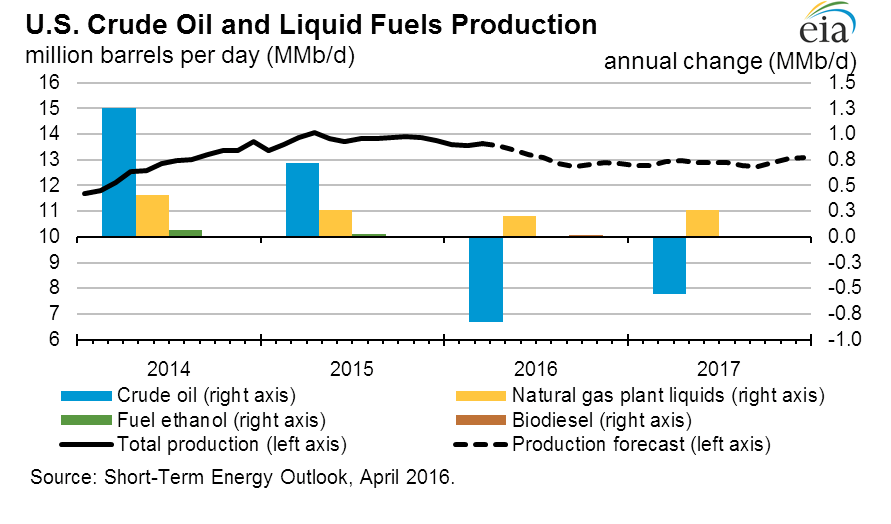
Conventional wisdom and economics say U.S. oil production will decline because prices are low enough to dissuade previous production levels, and indeed this is the case. Roughly 600,000 barrels had come off of the U.S. tally for crude oil production in March 2016 from an April 2015 peak of 9.6 million barrels per day (b/d). U.S. shale players are expected to further reduce their production output as prices in the $40 range hold back production for many of the shale basins in the U.S. On Friday, April 29th, Brent crude oil futures prices for June reached $47 and WTI nearly reached the $47 level.
Read More

Dollar Depreciates Further Against Major Currencies At Global Markets

The dollar reversed losses Tuesday after hitting multimonth lows against the euro and the yen, as investors took profits on bets against the U.S. currency. Measuring the greenback against a basket of 16 currencies, was recently up 0.7% at 85.20, boosted by gains against the euro, Australian dollar and emerging-market currencies. A sharp drop in oil prices is buoying the dollar against the currencies of commodity producing countries, including a broad swathe of emerging markets. The dollar was recently up 1.3% against the Canadian dollar at 1.2695. It gained 2% against the Brazilian real, at 3.5685, and increased 2.4% against the Russian ruble, to 66.74. Light, sweet crude for June delivery recently fell $1.20, or 2.7%, to $43.56 a barrel on the New York Mercantile Exchange on renewed concerns about weaker Chinese demand and growing global supplies.

The Australian dollar was recently down 2.1% at $0.7507 after
Read More

29 April, 2016

Ki-Moon to address Africa’s first ICCA congress on international commercial arbitration

United Nations Secretary General Ban Ki-Moon will address the 23rd International Council for Commercial Arbitration (ICCA) congress to be held in Mauritius from May 8 – 11.
Read More